Endgame Viable
Reverse Engineering Old Music Projects
Tom 1,641 words
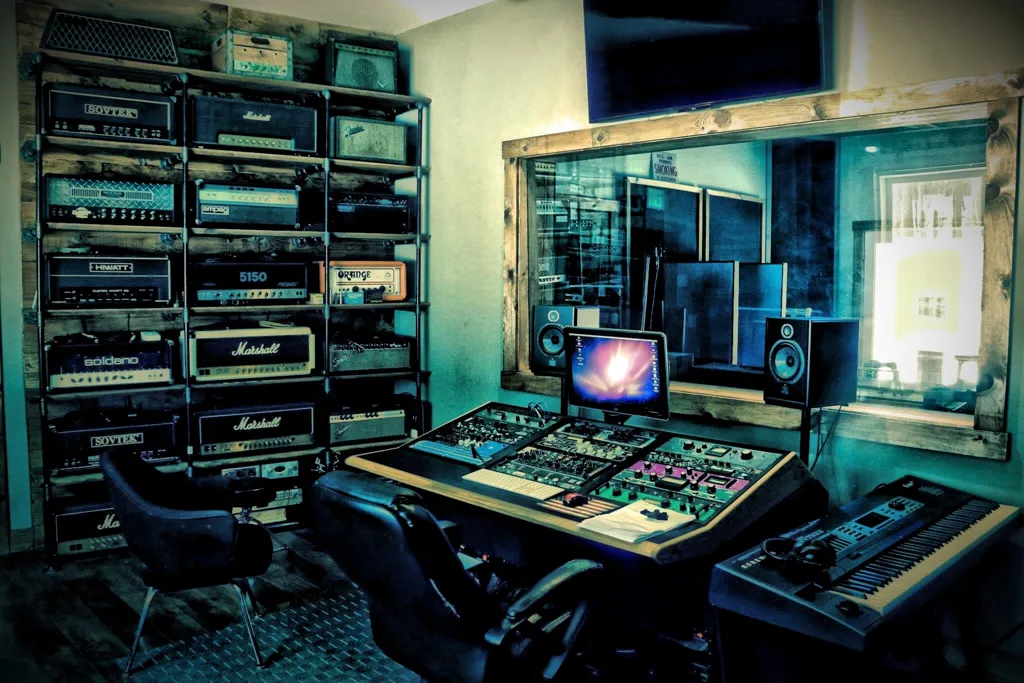
Hoo boy did I fall deep down a rabbit hole. Nothing else in life matters now but this.
Parking my Promise Table web site reminded me that I have an assortment of music I wrote and recorded in the mid- to late-90s just sitting around doing nothing, and I wondered what I should do with it.
In my old age, I feel like most of my historical “content” should be available online, whether it has any value or not. With my blog and my YouTube channel I’m quite used to “putting things out there” and getting at best a polite golf clap, at worst a deafening apathy, so the idea of publishing my music–the artistic endeavor that I slave over more than anything else–doesn’t bother me too much anymore. I fully expect people “won’t get it” and that’s fine.
There’s basically no chance of profiting from all that work (the music industry and consumer habits being what they are, the odds of any independent musician making money from music is vanishingly small these days–as are the odds of making money from any artistic endeavor–thanks “democratization of content”), so I just want to put them somewhere on the Internet where anyone can click on them and listen.
So the goal is to publish my old music. But how?
One problem I can’t quite overcome is I still have a strong interest in retaining the rights to my music. Artists have very few rights anymore, and copyright is one of them. Even if I make no money from my art, I still have rights to my art, and I should behave like a professional rights holder no matter what.
Many years ago, I registered all my songs with the U.S. Copyright Office. I want to distribute this music in a way that doesn’t completely undermine my rights. It would be foolish to expect anything good to happen, but it would be even more foolish not to plan for the one in a billion chance that someone slaps one of my songs on a TikTok video that gets 500 million views.
My first thought was to create a BandCamp account and upload my songs there. I have an assortment of 16-bit 44khz master WAV files I can upload.
Later I came to realize that I could fairly easily create a static web site that is essentially a player for my music, and I didn’t really need BandCamp or SoundCloud.
But I soon encountered a major problem. Back in the 90s, I judiciously used samples recorded from television, or downloaded from random sources on the Internet, and I didn’t keep track of where they came from or whether I could use them or not. They’re littered in my master recordings. They aren’t in every song, but they’re in the good ones.
Now I know better, and would never do that. So I can’t just drop those songs out there as-is, even though I have the master WAV files. I need to figure out how to creatively edit those mixes and masters to work around those samples.
For some songs, I can take the original mixdowns and cut and paste around the problem samples. For others, they’re buried deep in the mix and there’s no editing around it. I’d need to do a remix from scratch.
There’s another problem, though. Almost all of my old home studio gear is long gone, so recreating the environment in which I mixed a song from, say, 1995-1999, is nearly impossible.
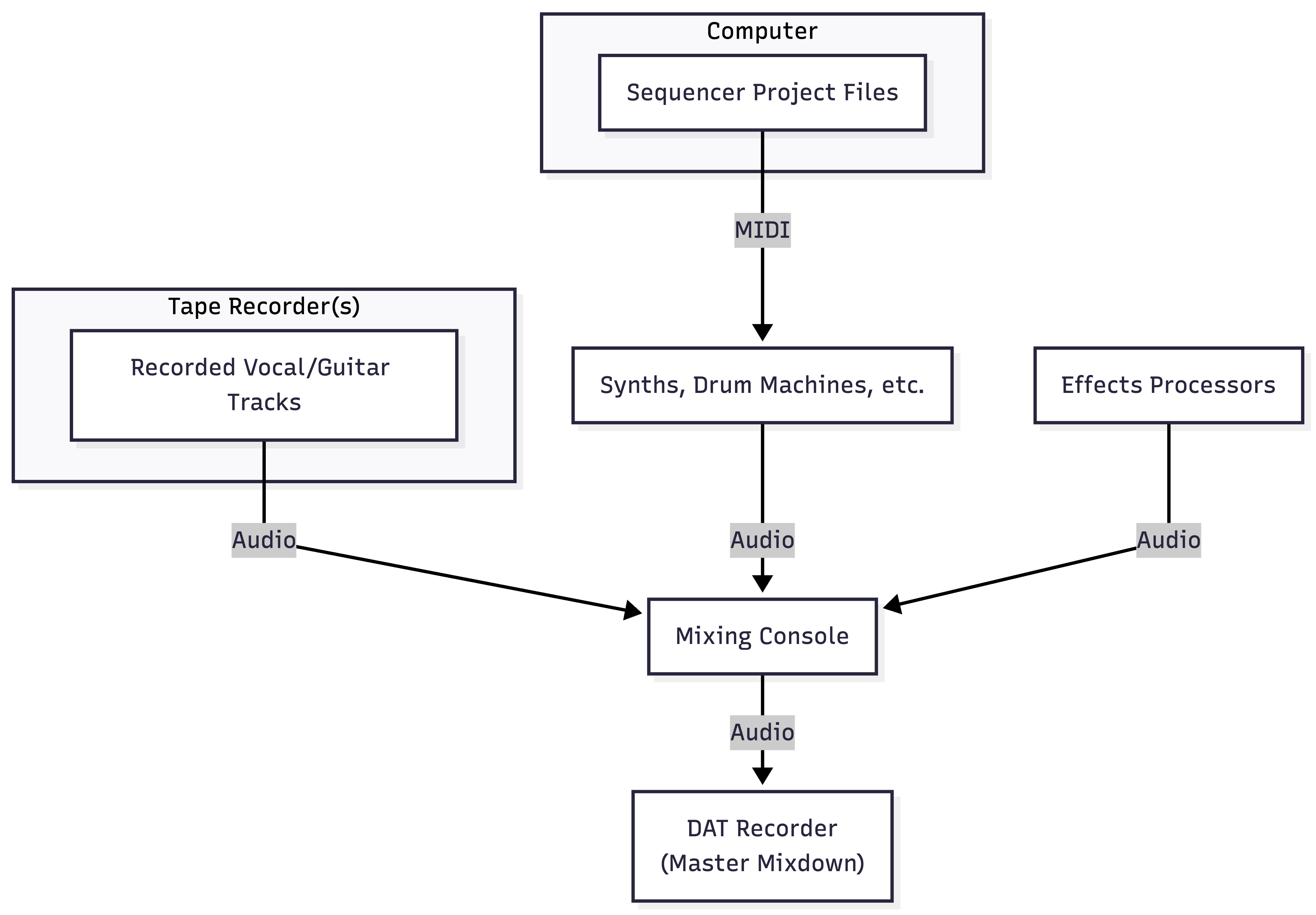
From that diagram of my ~1995 setup, here in 2026, I only have the Sequencer Project Files, the Recorded Vocal/Guitar Tracks, and the Master Mixdown DAT Tapes.
In 2013, I digitally transferred the recorded vocal and guitar tracks from the original ADAT digital audio tapes into REAPER projects. No problem there. Well, it’s mostly raw data files, so there’s a ton of organizational and synchronization work that still needs to be done… but the data is there.
However, back in the 90s, we didn’t have DAW workstations where we could easily record hundreds of digital audio tracks inside our computers. We (specifically I) had an 8-track ADAT synchronized with MIDI gear, and mixdowns happened by playing the projects live and recording the mix by moving dials and faders around.
But I don’t have any of that MIDI gear anymore. Or the rackmount effects units I used. Or any of the mixers or time synchronization devices or anything, really.
It’s an interesting logistical problem that engages my problem-solving engineering brain.
I have the project files containing all of the MIDI notes sent to those MIDI devices, which is the most important part, but I don’t have any recordings of the sounds those MIDI devices made, other than what you can hear on the masters.
So it’s a daunting task to try to reverse engineer, remix, and remaster these old songs to remove potentially infringing samples, even in today’s DAW world where mixing and mastering music is a breeze compared to what it was in the 90s.
Some songs I can reconstruct easier than others, but some songs are going to require starting from scratch. Some songs I want to remix just because I did a rotten job of it back in the 90s.
It all starts with finding and loading all of the old project files. In the 90s I used Cakewalk products (Cakewalk Pro Audio was the first DAW for Windows, as far as I was aware), so it’s all Cakewalk files. Luckily for me, there’s still a free download of Cakewalk SONAR that is available from BandLab, so I can still read those project files.
I don’t want to work in SONAR anymore, though. I use REAPER now. So there is a step of exporting those old projects and importing them into REAPER.
But the lack of MIDI devices is a big problem. Reverse engineering those older songs back to a point where I can work with them today, in a modern DAW context, is, well it’s already been said… daunting. But not impossible!
My rabbit hole project is starting down the road to recovering those songs and recreating my old recording environment in REAPER.
I set out to find VST plugins to emulate all those missing MIDI devices. The complete list of devices is: A Yamaha TQ5 tone generator, a Yamaha SY77 keyboard, a Roland SC-88 tone generator, and a Boss DR-660 drum machine. And there’s also an Alesis NanoPiano, but I actually still have that one.
There used to be a Roland Sound Canvas SC-88 VST plugin made by Roland, and I had it, and it was great, but they discontinued it and I failed to get the lifetime unlock license in time. Maybe there’s a pirate version out there somewhere.
ChatGPT told me about a VST plugin called Swayed which purportedly emulates a Yamaha SY77, including SysEx compatibility. I shall endeavor to try it.
ChatGPT told me about another VST plugin called KQ Trixie which purportedly emulates a Yamaha TQ5, including SysEx compatibility. Music I made with a TQ5 is very, very, shockingly old, and probably not suitable for public distribution anyway. But it would be nice to recover them just for my own amusement. (Much of that music was driven by an Amiga computer, before 1993.)
ChatGPT told me it was easy to find Boss DR-660 drum samples that you could load into whatever VST sample player you wanted, so that’s a potential avenue to explore. But I’m sure it would be a pain to setup. (I have a vague memory of setting that up before, actually, now that I think about it.)
I wondered if it was possible to buy those old devices again. I’m an affluent member of capitalist society, surely I can find a way to throw more money at this problem.
It didn’t take long before I found a used Boss DR-660 and a used Roland SC-88 on Reverb in good condition, and I clicked those Buy Now buttons. Could it be a scam? Maybe, but it’s a weird way to scam people. The SC-88 I bought is actually the Japanese version so I have to get a step-down transformer so it doesn’t blow up when I plug it in here in the U.S.
If those two devices work when they arrive, that will solve 75% of my problems. I can plug them in, play MIDI sequences to them, and record everything they do to one of a thousand DAW tracks in REAPER, and never worry about losing a MIDI note again.
Or, they could be lemons and I’ll be out a bunch of money and back at square one.
I wasn’t able to find any used Yamaha SY77 keyboards to buy, nor the rackmount TG77 tone generator version of the keyboard. The Swayed VST is my only option for now, or else replace all those parts with new VST synth parts by guesswork.
To reiterate, it’s a daunting project. It’s all in service of remixing and remastering some old songs to remove some samples, so I can set up a web page to publish them.
Since obviously nobody actually listens to music that way, I’m also investigating how music distribution works in the modern world for places like Spotify, etc. (Initial investigations provide an easy answer: DistroKid.)
Should anyone ever say to me, “Oh you wrote a song, can I hear it?” It would be cool to be able to send them a Spotify link or something.
So that’s my secret music production project. That was kind of a big wall of jumbled text up there, but that hurricane of disorganized thought closely resembles what’s inside my brain during sudden rabbit hole excursions like this. It’s an exciting time, and a challenging exercise just to bring some order to it.
Leave a Comment
This is a homegrown DIY comment system I've been working on. It works but technically you're beta testing it. Good luck. Go here to enter a comment on this post without Javascript.